Tuesday, May 5, 2015

How I set Up My Charts and Momentum Scans

When scanning for Momentum stocks, I to keep several scan windows with the criteria I am searching for so that I can sort it easy. 


The first window "Top Momentum" is all stocks that meet my liquidity stocks.  I generally keep this scan organized by stocks with the highest "MDT Daily" level.  

The Next Window "Power" is my bread and butter scan.  That is the Scan for the 3 year RSI high.   I can sort it for various criteria that I find useful.  MDT, Small Floats.  I have MACD column that I can see are checked for confirm. 

Finally, I have a window for IPOs because I find the IPOS to be profitable trading  vehicles after the initial washout. 

I set my "Big Gain Hunting" chart, up as follows:

  • Starting view is the Weekly 
    • I find that it filters out the he noise the best.
    • I will then look at other time frames when contemplating trades
  •  Wilder RSI. -- self explanatory. With breakout trades I like them above the Green line.
    • But when hitting the red on a weekly.  That gets a bit hot 
  • price chart.  I look at hundreds of charts and set the price alerts. 
    • I like simple charts so I only include a 10 and a 4 EMA on the chart.
  • Volume: nothing special -- I have an 20 day ma /4 week avg. to let me know whether volume is significant or not.
  • MACD: I combined my fast and normal MACD in one window. It is easy enough to see.
  • % to magic line.  I prefer taking trades that are close to the 10 Week Avg.  Breakout trades do not have to be extended. 


Sunday, May 3, 2015

Alexander Elder "Trading For A Living" Seminar.

Alexander Elder's books were very instrumental to me. Here is a great seminar. 

Your odds at the onset:
  • Average time for a speculator in the market is 2 years
  • 98% of traders lose money 
Take Aways
  • Trading can be like alcoholism
    • Once you look for excitement in the markets you are finished
  • Compares Losers Anonymous 
    • I can do serious financial damage to my account,  I've done it before and I can do it again. My only goal today is to trade sober.
    • Find discipline
      • Trade journal


Saturday, May 2, 2015

How To Develop A Trading Strategy

As traders, we talk a lot about trading strategies and  various setups. As helpful as that can be, I recognize that what is often lost is how traders we developed our respective  trading strategies. 
If you are a new trader you are probably thinking of where, or how do I begin? I've been there too. Before making the mistake of jumping to setup to setup, strategy to strategy, guru to guru, here's where I would recommend beginning.

Observe the Best Performing Stocks

 "A lot of people miss opportunity because it is dressed in overalls and looks like work."
--Thomas Edison
Putting the work in is the only way to have enough confidence to trade your strategy. Start studying Studying the stocks that make 8%-10% gains in a week, 20% moves in a month and 50% in a year.   Finviz makes it easy to do --- For free:

Now, look at the stocks that meet these criteria on multiple time frames. What do they look like on a monthly, weekly, daily, hourly? Where do they pull back. What is the RSI (or other indicators) at the time of the breakout on the m/w/d/h charts? What about the pull backs? Take notes , draw trend lines. Start thinking how and where would I get in to this stock? Also think about how you would scan for your particular entry?
 I can say that I worked backwords to come up with my trading methodology.  looked at those 50% gainers and tried to figure out how I could get in them, stay in them long enough, and get out safely.  After looking at the thousands of these types of moves, you will start to see things that can be used to put together your trading strategy. You should have a pretty good Idea of where you want to get in those stocks.  There is no right answer.  There are numerous uptrend strategies that work.  For example:


  • Range expansion
  • pull back to support or MA
  • Breakouts
  • Backtests of B.o. 

CREATE SCANS TO FIND THE STOCKS THAT MEET YOUR CRITERA

Now that you have an idea of what you want to trade, you will then want start thinking about how you will find those stocks.  If you are relying on others for your ideas you are not a trader.  Let that sink in.
To become a trader you must be able to articulate your set-up criteria and know how to find it.  It is easy to find a scans in various forums, but that really is not helpful until you know why you want to scan for a certain condition.  
I personally found that taking the time to think about what I am scanning for and how I will do it is extremely helpful in defining the setup as you are forced to write out your rules. 
For example, consider a goal of "I want to be in strong stocks that are breaking out"
How will you define a "strong" stock? 
There are many ways to define a strong stock.  You could consider how strong the trend is? A particular RSI level, etc... Whether it has "good" fundamentals (which would also have to be defined), is it an IBD 50 stock?  The point is that there a multitude of ways to quantify strength. Just do it consistently and then you can create scans for those criteria.
What is a breakout? 
A breakout should be defined by a time frame.  Some traders use only closing prices some use the daily high.  You would need to decide how you would define it, scan for it, and then trade it.

MANAGE THE TRADE

After you are in a trade, there are numerous considerations. 
  • How much risk am I taking (you should know this before you take the trade)
  • Where do I get out if I'm wrong
  • How do I take profits?
    • Partial
  • Do I take a binary risk? (i.e. a trade into earnings)
These questions and considerations need to be thought out as you are doing your research for entry strategy.

WORK TOWARDS PERFECTION


One of the things I enjoy about trading is that it is a constant work in progress.  No one is perfect.  Tinker, add new setups.  Have fun.


Wednesday, April 29, 2015

Why I went to Cash


I went to all cash on Monday morning selling my positions one after another like dominoes going down.  The reason I did was that I got a big warning on the market monitor. Over 20 Stocks were up over 50% on April 24. What the 20 > 50%  signals is that there is over exuberance in the market the bullish side. That's the equivalent of red lining your car.  You could push it more... but its not going to end well. 


The Beer Goggle Effect

After a big run, you will start to see the quality of setups diminish.  Nonetheless,  many traders start getting beer goggles and start thinking that every setup looks good.  Next thing they know it they wake up the next to something hairy and it hurts when they pee.    


In my opinion, the market needs to hit the reset button here and clear the junk out so that the good risk / reward trades are allowed to present themselves.

Remember, cash is a position and sometimes it is a very good position.

Cheers!

Saturday, April 18, 2015

Review of www.Stockbee.biz

I thought I would do a post about the stock trading sites I subscribe to, why I subscribe to them, and how I am trading the setups utilized by those sites.

The trading community that I have been a a member of the longest is a momentum trading group called

Stock Bee.


Stock Bee is run by Pradeep Bonde (a/k/a Easy Guru).   I followed his  free blog for over a year before taking the plunge and becoming a member. I have been a member for about 8 months now. I believe its about $300 for the year. It is an excellent value for the expense.

Subscribers are afforded access to a vibrant community with some excellent traders.  You will find that there a number of different strategies that are traded and members are very helpful showing the ropes to new traders and sharing the nuances of their setups and systems to each other.

You will not find stock picks here.  I like to tell my friends that Stock Bee trades setups not stocks.  By that I mean, there is a hyper focus on the quality of  individual setups but there is little to no discussion of the fundamentals for those stocks.

With that caveat, the bread and butter setups taught by Stock Bee is the the "Momo Burst".  The Momo Burst was a significant part of my trading strategy and a big reason why I made 47% last year.

A momo burst looks for:

(1) stocks in an uptrend (preferably the beginning of a new trend)
(2) a period of range contraction
(3) a range expansion that is bought
(4) a 3-5 day move

Risk Mangement:

(1) stops generally placed at the low of the day.  Stop hunting algos? We don't care a good burst should never look back.

(2).  EG's trade risk is usually around .25-.5 per trade, But I usually go 5 to .75 of my equity on a trade.

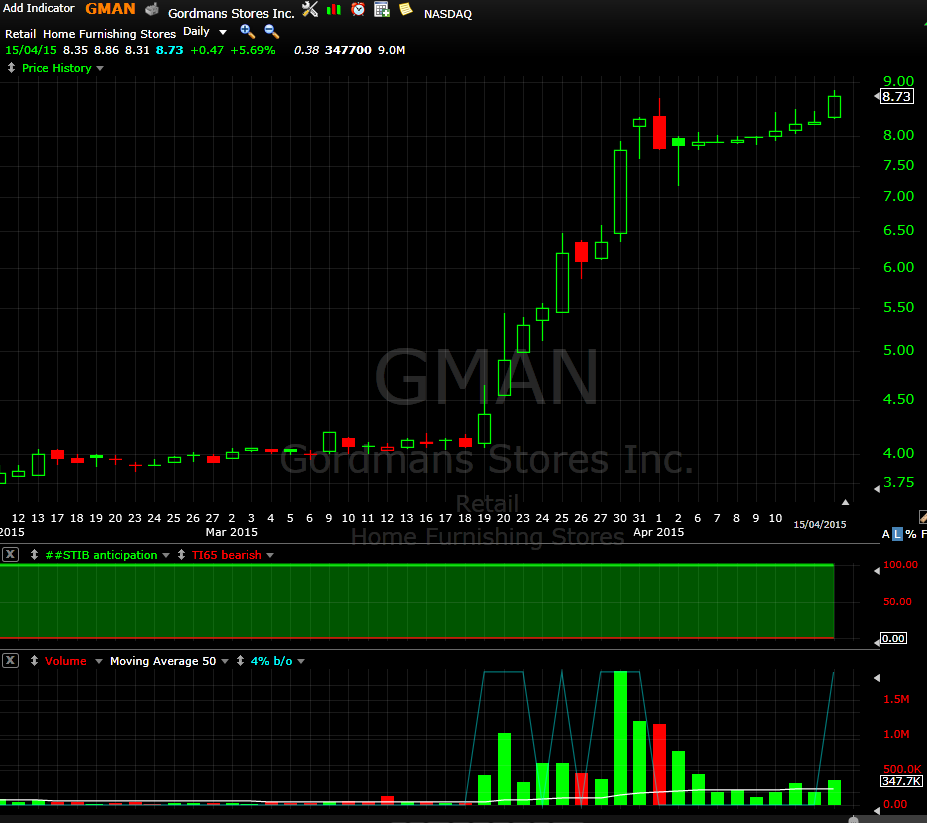
Stock's Free Blog highlighted  GMAN as  good setup and it is a perfect example of what an ideal momo Burst would look like.

It had a very powerful move and has then entered range contraction and on the right edge expanded.


PROS:
This set up appears 1000s of times a year.
Many opportunities to practice the trade
A postive expectancy.

CONS:
Are you mentally prepared to make 100s of losing trades a year? 10 loses in row?
Can be mentally exhausting

My Experience
 I had a 57% win rate in 2015 and an avg win / loss 1.03 / 1.00.  So not great but that small edge builds up over time.  Even so, I can attribute  a lot of my gains to just a few trades. For example, I had a trade in RWLK  I risked . 25% of my account and made 6.6% gain on my account on just a 1 day Burst.

My chief disappointment with the system is that there are a ton of failed range expansions and also there were a number of burst I sold for 5-8% gain winners on stocks that would run 100-200% from that point.

I want the monster moves!

The "Episoidic Pivot"  The EP trade is supposed to go after the monster move.  The Theory is that a stock goes through an major game changing event such as fantastic earnings after being neglected for years.  Stock Bee's summary is here.

On an EP you want to buy as soon as it happens even pre-market and your looking for 50% + gains moves. You want to see massive volume and a gain changing news:


Pros:
The gains can be enormous.  Jesse Stine used this type of strategy to take his account from 46K to over 6 Million in under 3 years.

Cons:
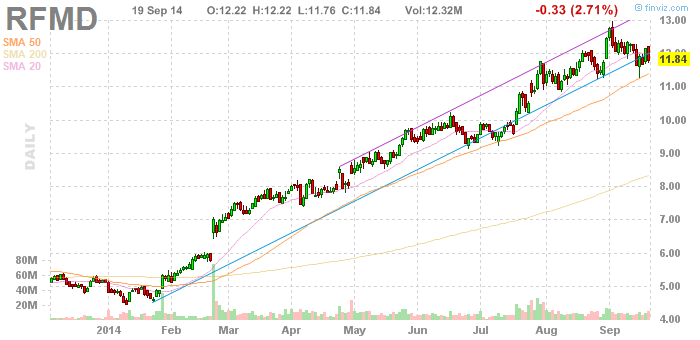
The setup appears infrequently.  The only EP I've had were NOK when it sold it's phone division to MSFT and RFM when it merged with TQNT.


My Experience:

I've been awful with this setup.   The true EP appears infrequently and there are many false positives. If you are buying pre-market gaps on non-EP's you usually get stuffed.  A lot of times great earnings can be subjective, and how do you really know whether a bio tech's news on a phase 1 or 2 trial really has significance?

I've also noticed that there are many stocks that make fantastic 100% +moves without ever having a true "EP"

It is these stocks that I've been studying and trying to figure out how do I get in them. Perhaps there's a way to quantify an EP type stock without having to read the tea leaves in press releases?


Update 2018:

My favorite part of stockbee is the forum-- which I affectionately call the beehive.  There are many different styles of traders in the room.  Although I've since moved to a longer term focus since first joining, there are other traders in the group that use my approach.  Others are 100% mechanical and there are a few day traders.

The people I've met in the group include people that that have placed in trading competition and are now doing national speaking engagement.  So its an amazing opportunity to learn from some great traders. I have benefited immensely from the free flow of ideas.



Wednesday, April 8, 2015

The Struggle

I hit this one of on a pull back to 13.90   On a weekly I can see there is a Week 1 breakout and this thing is going higher. Easy right.  Not so much.

Yet I sold it yesterday after watching this painful hour, sure it was only a .70 drop, but when you have profits and your seeing them rapidly evaporate you start thinking where's the bottom? Am I going to give it all back.    So I pull the trigger and take a 10% gain.

 Of course the next day, ADXS rockets for 17%, which is why I write this post. After all, if it had continued to drop, I would just think I'm smart.  Oh well, something to work on.

For whatever reason, It is easier for me to sit through a pull back and keep to the plan if I don't have big gains in a stock.   On those types of trades I know where my stop is going to be when I take it. If it goes against me fine, that's expected but when I get up big the exit is not so clear.


Sunday, April 5, 2015

Chasing Power


Eric Muathe's  You Tube Videos are a must see for the traders looking for big moves.